Creator vetting
Before You Pay an Instagram Creator, Check More Than Their Follower Count
A clean grid and a big follower count only tell you how a creator presented their page on the day you opened it. Before you wire a deposit, a few plain public checks over two weeks show whether that audience is growing or walking away.
Most small brands still pick Instagram creators the same way they did five years ago.
A teammate drops a handle into Slack. Two people look at the grid, see 48.3K followers, check whether recent Reels broke ten thousand views, like the lighting, and send over a $1,200 brief. Three weeks later, the post goes up and brings in fourteen link clicks and zero orders. After one or two campaigns like that, the team decides influencer marketing does not work in their niche.
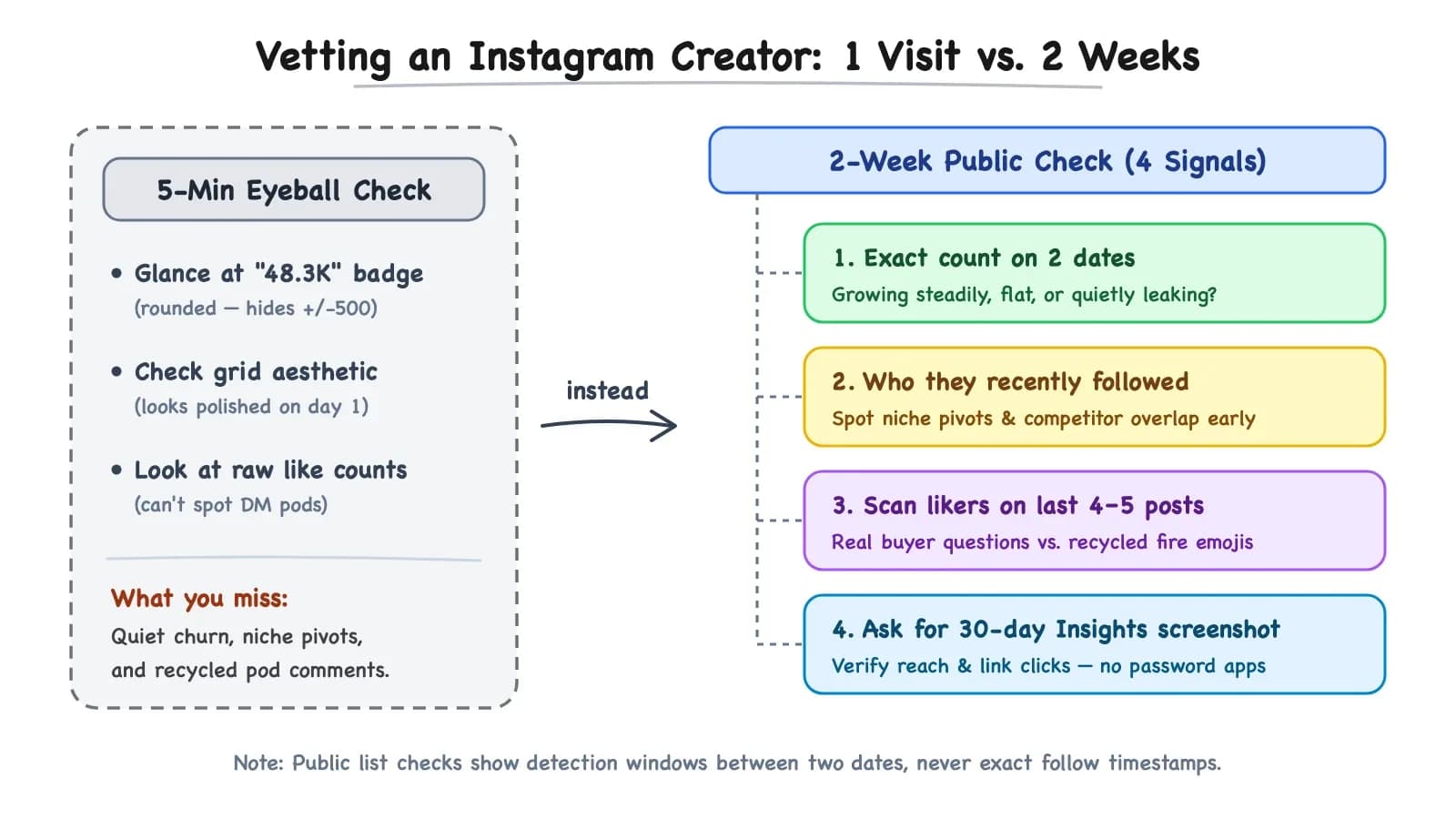
The five-minute profile check causes most of those misses.
One afternoon visit misses the trend
Once a public Instagram profile crosses 10,000 followers, the header stops displaying an exact count and rounds it to something like 48.3K. On a single visit, you cannot tell whether that creator gained 600 followers last month or lost 600 over the same stretch. Even if you jot down the exact number once, a lone figure gives you no sense of direction.
When your campaign schedule allows it, start watching shortlisted creators two or three weeks before sending contracts. You can spot momentum from public profiles alone. Checking exact counts on two or three fixed dates, or comparing complete public follower snapshots over time on PenguinRadar, shows whether a handle is picking up new followers or churning through old ones without asking for a login.
If you run a Professional account of your own, Instagram Insights shows exact gained and lost totals going back 90 days, which gives you a baseline for normal weekly movement. Outside creators have to send screenshots of that screen voluntarily, and it is always worth asking for them before paying a larger fee.
A creator's public Following list shows where they are heading
Most brand managers inspect follower counts and skip the public Following list completely.
For small and mid-sized creators, the accounts they follow are usually far fewer than their followers, so changes are much easier to compare cleanly. Watching who a creator starts following over a couple of weeks often tells you more about their next content shift than their bio does.
Say you run a skincare brand and look at a lifestyle creator whose bio still says "clean beauty & daily routines." If their public following changes over the past month show eleven new home-renovation and tile accounts and zero skincare founders, their focus is probably drifting out of your category. You might also spot them following two of your direct competitors right before pitching you for a sponsorship.
Instagram does not publish timestamps for public follows, and the old Following Activity tab disappeared in 2019, so you will never know the exact hour a creator tapped Follow. You only see what was detected between two checks. If you would rather not compare lists by hand, PenguinRadar lets you preview recently followed Instagram accounts on a public profile with free credits, or track ongoing changes across a shortlist. Knowing which brands or niches a creator gravitated toward over recent weeks still gives you useful context before spending budget.
Check who likes the posts
A Reel with 1,200 likes and a Reel with 400 likes can perform very differently when you check who tapped the heart.
Open the recent likers on a creator's last four or five public posts, or pull them up in PenguinRadar Instagram Likes Viewer, and spend three minutes scanning the handles. You want to see whether plausible buyers appear in that crowd.
On healthy niche accounts, you find ordinary personal profiles alongside a few local shops and peers in the same space. On inflated profiles, the pattern shows up fast: the same group of 20 creators leaving fire emojis within ten minutes of every upload (a typical engagement pod), or rows of blank zero-post accounts that are unlikely to buy a $60 product next week.
Comments deserve the same two-minute read. Eight specific questions asking "does this fit wide feet?" or "how long does the bottle last?" tell you far more than ninety one-word compliments from fellow influencers trading favors.
Where public Instagram data stops
Public Instagram data has clear limits, and keeping them in mind prevents bad calls.
Skip any audit app that asks you or a creator to sign in with an Instagram username and password. Instagram's help docs warn that sharing login credentials with third-party apps gives those apps full account access and can trigger restrictions. Stick to what is openly visible on public profiles, plus whatever native Insights screenshots the creator agrees to share.
Messy public lists are also common and do not prove fraud by themselves. Verified creators restrict how much of their follower list is publicly readable, and ordinary public pagination drops rows more often than most marketers expect. That is why reliable tracking waits for complete lists before flagging a drop, as we explain in how PenguinRadar compares scans. Instagram also regularly removes disabled and fake accounts, and regular users deactivate their profiles for a few days when they take a break. An overnight drop of 25 followers does not prove a creator bought bots yesterday.
Keep your date notes accurate too. Checking a creator on October 12 and again on October 26 gives you a two-week detection window. Two clean weeks of observation is enough for a campaign decision.
A ten-minute shortlist habit
Keep one plain spreadsheet tab for each campaign and start it two weeks before briefs go out.
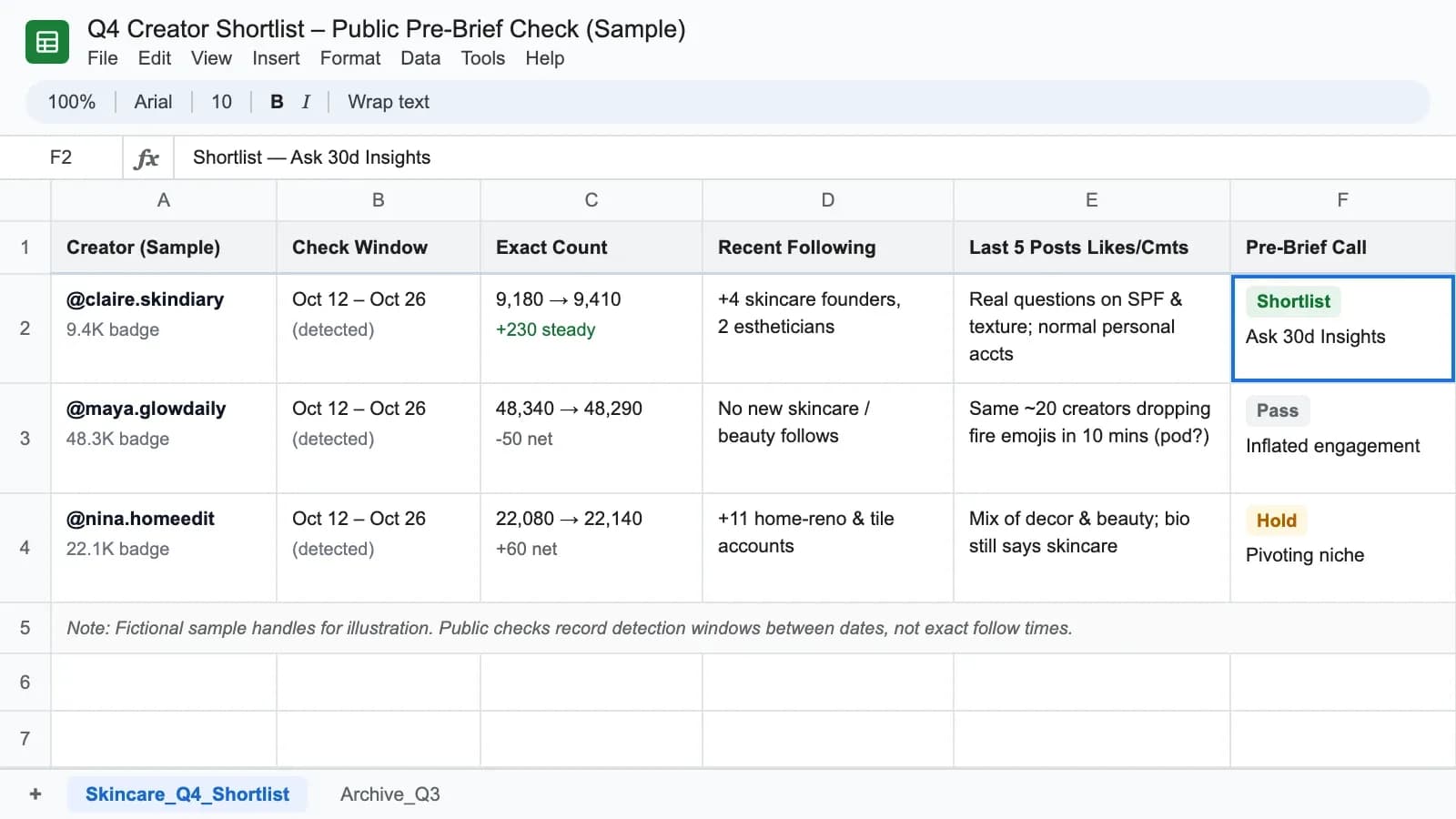
For every shortlisted public handle, log four simple checks. Track whether their exact follower count moved across two dates. Look at who they started following recently. Scan the likes and comments on their last few posts for signs of real buyers. Ask for a straightforward 30-day Insights screenshot covering reach, profile visits, link taps, and top audience locations.
That last detail catches a common blind spot. A creator with strong engagement can still miss your market if most of their viewers live outside the countries you ship to, or fall well outside the age group that buys your product. Asking for one screenshot of their audience geography and 30-day external link taps takes thirty seconds and answers questions no public profile can show.
A creator with 9,000 recognizable, engaged followers in your target market will outsell a stagnant 60,000-follower account every week.
More from the blog
- UnfollowsHow to See Who Unfollowed You on Instagram, and What Free Methods MissInstagram has no unfollower list. Here are 3 ways to see who unfollowed you, which ones are free, and why a missing name isn't always an unfollow.
- Follower countsWhy Your Instagram Follower Count Can Stay the SameYour Instagram follower count can stay the same when people join and leave. See why this happens, how to check the list, and what a follower tracker can miss.